


“I will not use AI, because of the water.”
That was a ten-year-old girl in my ethics class. I teach ethics in my lunch hour each Monday at my son’s local primary school. When I announced we’d be discussing AI, she had her answer ready before I’d finished the sentence.
I can empathise with her concerns. Australia is about to build a great many data centres, but somewhere inside that build-out will bring a wave of sustainability roles that do not yet have proper names. Here we go again, I hear you cry! But seriously, if you are a mid-career specialist wondering how this will affect this is an area I would recommend observing closely.
As a daily AI user, I care about the environmental cost of data centres. So on Monday 7th September I joined the launch webinar for A Better Model for Data Centres: A Community-Counter Offer. It’s an initiative by Highlands Homegrown Economy, RadicalxChange, Regen Labs and BWD Strategic. They’re working with locals in the Southern Highlands in response to a proposed development by Sydney-based company Cloud Carrier.
According to the organisers, the proposal could involve an increase in greenhouse gases, along with a significant draw on local water. More than 160 people joined the webinar. People care.
I also learned that AEMO is tracking 225 data centre projects at various stages of connection. Not all will proceed. More than a third of last year’s list has already been cancelled. But AEMO still expects data centre electricity use to grow sevenfold in a decade, from around 5 terawatt hours today to around 34 by 2035-36. That would take data centres from about 3 per cent of demand on the national grid to about 13 per cent. Investment forecasts run into the hundreds of billions of dollars.
So there is a lot to think about. As always, though, with my coaching cap on I like to think about the part that matters for your career, which is of course quieter. On 26 August 2026, National Cabinet agreed to develop mandatory national standards for large data centres, covering energy, water and land use. The agreement also covers skills and training. The federal government plans to legislate in early 2027. When a sector gets standards, it has to hire people who can meet them and prove it. That second half is where the work is.
What the work actually looks like
Water accounting at facility level. The industry talks fluently about cooling efficiency. Far fewer operators publish total facility water use, including what evaporates, what is discharged, and where it was drawn from. The new standards will cover water, though the detail is still to be written. People working in this space will need to build that number, defend the methodology, and get it signed off. That is a job, and I doubt there are many people doing it right now. My ten-year-old student’s concern is a very valid one.
Verification rather than reporting. Reporting tells you what a company says about itself. Verification tests whether the claim survives contact with evidence. Data centre operators are making significant environmental claims right now, on water, on energy, on efficiency. The market has very little independent capacity to check them. That gap will need to be closed by hiring verification experts.
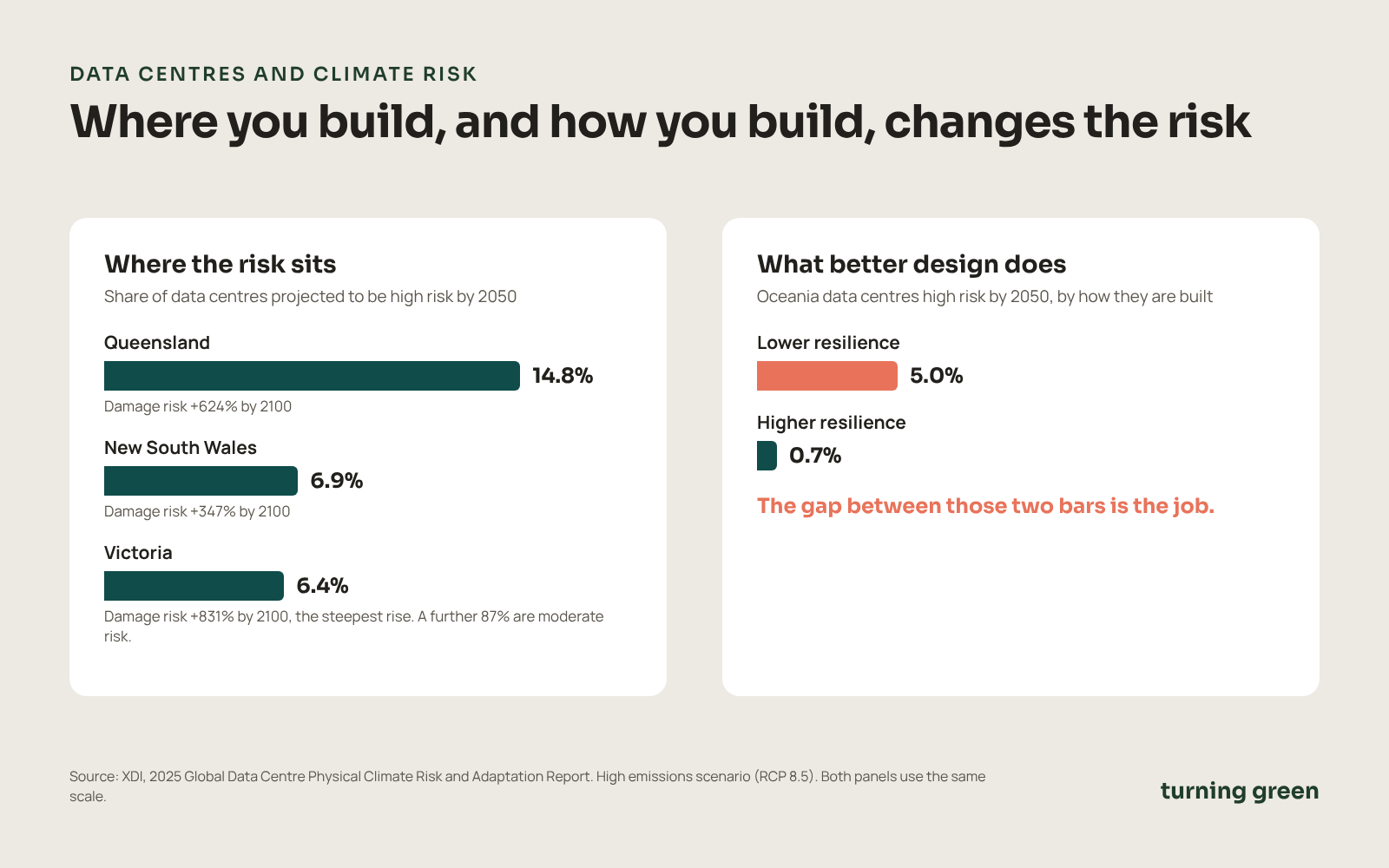
Physical climate risk at asset level. XDI analysed 8,868 data centres worldwide for its 2025 report, under a high emissions scenario. In New South Wales, home to the largest share of Australia’s, 6.9 per cent are projected to be high risk by 2050. Surface water flooding is the driving hazard, and damage risk rises 347 per cent this century. Queensland is higher still, at nearly 15 per cent. Victoria shows the steepest increase of any Australian state, at 831 per cent. Yet XDI found that building to higher resilience standards could cut damage risk across Oceania by 84 per cent. Insurers and lenders are already pricing this. The role that emerges sits between the engineering model and the investment committee, and translates one into the other.
Community consent and value capture. This is the one most people underestimate, and the one being expertly addressed as we speak and as a resident of Berry NSW, it’s why I was drawn to attend the data centre webinar to see what I could learn. A I mentioned earlier, in the Southern Highlands, a 703 megawatt gas-fired power station has been proposed to run a single data centre campus. The community response has gone beyond opposition into something more interesting. It’s a structured deliberation about what conditions, if any, would make a project acceptable, and what lasting value the region should receive. Running that well involves disciplined, deliberative facilitation, benefit-scheme design and community wealth building. Australia has very few practitioners, and demand is about to outrun supply badly.
Energy market literacy. The Commonwealth wanted new data centres to support additional renewable generation, but that requirement was dropped during National Cabinet negotiations following Queensland’s push for a technology-neutral approach. The question now is how the final rules will be designed and enforced, including what qualifies as “additional” generation, how renewable energy certificates and power purchase agreements are recognised, and how grid connections are managed. For anyone working on the energy side of the data centre sector, understanding how these decisions affect project costs, electricity supply and compliance will be essential.
What this could mean for your career
At a certain point in a sustainability career, the next step can become harder to see. You’ve developed strategies, managed reporting and worked through plenty of materiality assessments. Moving into a bigger role might mean more of the same, just with a larger team. Building expertise in a new area could offer a different way forward.
Data centres are worth considering because sustainability questions have a direct bearing on whether projects proceed and what they cost. The work requires a sound understanding of energy, water and infrastructure, and the ability to explain and defend your analysis when the findings are commercially inconvenient.
For experienced sustainability professionals, there could be an opportunity to get involved while the requirements—and the jobs needed to meet them—are still taking shape. That doesn’t necessarily mean changing employers. It might start with taking responsibility for a project that stretches your technical knowledge.
Three things to watch over the next year
What the standards actually require. Which facilities will be covered? What evidence will operators need to provide? How much will the requirements differ between states? The answers will help determine whether operators need specialist expertise or can handle the work within their existing teams.
Whether operators must disclose water use for each facility. Mandatory reporting would create a stronger need for reliable site-level data and people who can produce and check it. Voluntary disclosure can still involve substantial work, but the demand is likely to be less consistent across operators.
What communities receive beyond construction jobs. Yes, construction jobs matter, but they don’t last for the life of a data centre. Waste heat recovery and shared local infrastructure could provide longer-term benefits. If negotiations extend to community ownership, levies or long-term funding arrangements, operators and communities will need advice on how to structure and manage them.
These are the details I’d follow when assessing career opportunities in the sector. They will give a better indication of the work ahead than broad commitments about sustainable development.
A note of caution
I wouldn’t suggest there is already a large pool of senior roles waiting to be filled. There is investment, public scrutiny and regulation under development, but that doesn’t tell us how many people will be hired, when, or at what level.
Climate-risk and nature-related reporting offer useful comparisons, rather than a guarantee of another hiring wave. As those areas developed, there were opportunities for people to build expertise through their existing roles and move into more specialised work.
That seems a sensible approach here, too. Before making a major career move, look for a chance to work on a relevant project, learn alongside technical specialists and understand the decisions operators are facing.
Experience in strategy and reporting remains valuable. Adding the technical knowledge to assess a project’s demands, test its claims and explain the trade-offs could give you more options - and a stronger case for taking on greater responsibility.
Whether that convinces the ten-year-old is another matter.
Views here are my own.